
Subscribe to continue reading
Subscribe to get access to the rest of this post and other subscriber-only content.

Subscribe to get access to the rest of this post and other subscriber-only content.
 I began section hiking the Appalachian Trail in 2009. The over 2000-mile trail begins at Springer Mountain in Georgia and ends at Mount Katahdin in Maine. Some hikers choose to hike the entire trail within one hiking season, usually taking 5 to 6 months. These hikers are referred to as thru hikers. And some, like me, choose to hike a section each summer. Being a teacher and having several weeks off in the summer allowed me to hike a section in 2009, 2010, 2011, 2012, 2013, 2015, 2016, and 2019. Of those years, some were good hiking years and some not so good. Like the year when I fell and broke my leg. However, this past year was one of my favorites because I shared the trail with my grandson.
 When my grandson was 2 years old, I bought him a red A.T. tee-shirt with the slogan, “Hiker in Training”. Then for his 3rd birthday I bought him a backpack with A.T. boldly printed on the back. Through the years he asked a few questions about the trail and in 2015, his mommy hiked in a group with me on the trail. She got to see a bear and a snake. But, when she came home with her A.T. stories, I think, that was when he began to ask about when he would be old enough to go backpacking. So, in July of 2019, my grandson and I headed to Harpers Ferry, West Virginia to spend a night at the Tea-Horse Hostel and backpack from Gathland State Park in Maryland to Harpers Ferry on an overnight hike.


The Tea-Horse Hostel in Harpers Ferry comes highly recommended from this Grandma, aka Memaw. The hostel keepers are friendly and accommodating and assisted in keeping a young section hiker in a wholesome environment. After a night of sleep in his upper bunk, my grandson was dubbed Bacon, as a trail name, while he ate a lot of the bacon that was served at breakfast the next morning. All the thru hikers were encouraging and thrilled that a young section hiker was in their midst.
The hostel keeper shuttled us to Gathland Park, Maryland and we began the southbound hike toward the Ed Garvey Shelter. Bacon carried his backpack, prepared his lunch, kept up a good pace and when we reached the shelter, he helped to filter water and set up camp for the night. While eating a snack, Bacon watched a doe and fawn that without fear, leisurely grazed about 10 feet away. Bacon also decided that cold soaked Ramen noodles might be better than cooked Ramen noodles after a long day on the trail. And, the traditional space ice cream, well, not his favorite.


We were joined by thru hikers throughout the evening and although usually frowned upon, everyone was completely understanding of the tent that was set up on the second floor of the shelter. After an active day we were ready for our sleeping bags before dark. In the middle of the night, a loud bang woke both Bacon and I. We were sure a bear was in camp, but we didn’t hear anything more and fell right back to sleep. It appears that perhaps something fell out of the tree onto the tin roof of the shelter.


The next morning, we woke early and ate a quick granola breakfast before packing up and leaving the shelter. We went southbound again and descended the Weaverton Cliffs then walked the tow path that runs along the Potomac River. I do have to say that I had a moment of memory lapse and wound up off the trail for about a quarter of a mile, but the Guthook App quickly let me know that I had misunderstood the direction of a double blaze and we were able to backtrack before going any further. Bacon was tired but kept on walking with his backpack until he reached Harper’s Ferry. I had a, “make a memory moment” when he was walking in front of me while we crossed the Potomac River into Harpers Ferry. That little boy, that is so special to me, had just completed his first section of the Appalachian Trail at the age of 9 years old.
We took all the pictures that are special along the trail and then later that day we took a picture that will always be extra special to me. Our hiking adventure had begun and ended in Harpers Ferry, West Virginia which happens to be the Appalachian Trail Conservancy Headquarters. I had never registered as a section hiker, but on this day, both Bacon and I/Specs registered and received our tags and numbers. We will forever be beside each other in the books with a picture of each of us standing in front of the conservancy.


As I said, many years on the trail were really good and some not so good and at least one, extra special. Bacon, thank you for the memory. Specs, aka Memaw.
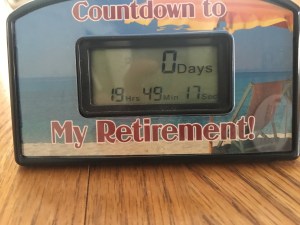
On February 15, 2019 I finally submitted my intent to retire from my career. It was hard to make the decision to stop doing what I have done and loved for decades. It was hard to say, I am going to begin a new season in my life. It feels like I have done that a few times in my personal life and the outcome was always favored and worth the change but it was usually painful and riddled with anxiety. So when considering retirement, I was certain that the same would be true. On that day, when I slid my intention paperwork across the table to my supervisor, I will not deny I was a little scared, a little excited, and a little uncertain that I was making the right decision. And on this day, several weeks later, I am still a little unsure and a little anxious of the outcome. But, I am also excited at the possibilities that lay in front of me.
As I have come to terms with the possible new me in a new role, the most surprising realizations have come about. I have become more comfortable in my skin. There is a peacefulness that has entered my soul in knowing that I am in my last days of this career. I no longer rush to work or rush to get everything completed in a day. I just do it. I get to work. I get the job done. I do my best and I take a minute to look at the child I am working with in that moment and I make a memory. I remember the sounds and the sights of the classrooms and children. I have chosen to allow more authenticity to enter my life in my appearance. I no longer feel the necessity to have hair that looks younger than my years. I did cheat and do the painless transition, so overnight I had salt and pepper hair that will continue to grow. I only have to go to the hairdresser once every two months for a trim. The freedom of the time, money, and anxiety of whether my roots are showing is amazing to me. I went shopping for some new dress pants and realized that I don’t need dress pants any longer. So, I bought yoga pants instead.
I have had some moments of anxiety that I am losing my identity. When I am asked who I am, my answer has always included teacher. I am learning though that teacher was never who I was, it was simply what I did.
I have had some moments when I felt disappointment because I will not be doing some of the things that I somehow thought that I should be doing now that I am retiring. Like, I am not moving to Asheville, North Carolina to help shuttle through hikers. I am not moving into a tiny house so that I can live off grid and debt free, and I am not moving closer to my children so that when I am old they can take care of me. Then it hits me. I really don’t want to move anywhere. I don’t want to live in less than my 1300 square feet, without electricity and running water, and I don’t want to live in the mountains. I like living on flat land that allows me to easily ride my bike and push my lawn mower. I also have no desire to put smelly hikers in my vehicle to take them anywhere. Laughing out loud to myself. I have a wonderful relationship with my children and I don’t think living closer to them would change a thing and I have no desire to saddle them with my care when I am too old to care for myself. A long term care insurance policy should pay for someone else to do that.
So, what will I do?
I will do what I have always done. I will grow a garden in the summer. I will preserve the vegetables that I grow. I will cook good food for myself and my friends. I will kayak, camp and hike. I will play bridge, badly. I will visit my children and grandchildren often. I will read biographies and novels about far off places while I snuggle in front of my fireplace in a comfy chair. I will knit. I will sit on my porch and watch the sun sink into the horizon. I will play with my dog, Ernie, and take him for long evening walks. I will enjoy my special friend, Alan, as we explore new places and have new adventures. I will work with babies with blindness and teach their parents how to care for them. I will go to my church and I will rest in His peace daily. I will live a good life.
The Lord will fight for you; you need only to be still.
Exodus 14:14
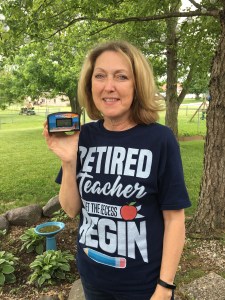
I have recently had several request for my kombucha recipe. Kombucha is a probiotic that has many health benefits. It became my healthy way to replace soda pop in my diet. I like fizz and I like it sweet. After going to the store several times a week and paying for the store bought kombucha, I knew that I needed to learn to make my own. I would like to say that I started making kombucha and all was well. However, that was not the case. I made several batches that just didn’t taste like what I was able to buy at the store. Mine lacked fizz and at times it simply tasted like spoiled fruit. Over the last couple of years and sporadic searches on the internet, I think I finally have a recipe and a method of making komucha that is pleasing and contains the fizz and sweetness that I like.
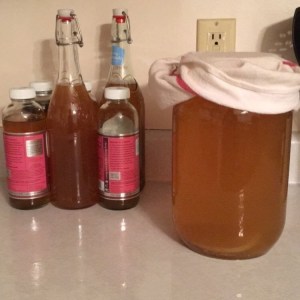 To make your kombucha, you will need
1 gallon jar
cotton dish towel
rubber band to fit around the opening of the gallon jar
1 bottle of your favorite unflavored kombucha
several bottles for the second fermentation
your favorite organic juice.
6 tea bags (black or green tea do best)
1 cup sugar
To start you Scoby (sometimes the scoby is called the mother)
Beginning your first fermentation:
Second Fermentation:
Kombucha is Ready!
Serving Kombucha
Enjoy
Cream of Tarter:
I recently had a house guest that informed me of an excellent mosquito repellent. On several evenings we sat on the patio at my home. I had used a typical spray on mosquito repellent along with citronella candles. Although I had taken all of these precautions, I was suddenly poka-dotted with bites and was awakened to itchy bites over my entire body. They had even bit me through my shirt to leave itchy spots on my back. My house guest however did not seem to have any bites. Hum?
He shared that he had been taught to drink a teaspoon or so of cream of tarter in a glass of water as a natural way to deter mosquitoes.
After he had returned home, I was again attacked by the mosquitoes while I sat outside to watch the fireworks. Remembering what he had said, the next day I drank a teaspoon of cream of tarter in a glass of water. I did not taste bad and best of all, I have not had anymore mosquito bites. I have been visiting with family in the south and worked in my yard. I have seen mosquitoes flying near me, but they do not land on my skin.
I hope this helps others in their quest to avoid mosquitoes this summer.

After a long day I was surprised with homemade vegetable soup and homemade bread with a glass of Der Champion from Buck Creek Winery.
The vegetable soup has been a work in progress and is now perfection.
Vegetable Soup
by Alan Jung
@alan_jung
2 medium onions chopped
3 ribs of celery finely chopped
saute these in a tablespoon of olive oil
add
3 minced cloves of garlic
28 oz can of diced tomatoes
14 oz can cut green beans
14 oz can of wax beans
14 oz can carrots
14 oz can diced potatoes
14 oz can corn
15 oz can tomato sauce
14 oz can black beans that have been drained and rinsed
salt, pepper and cayenne pepper to taste.
simmer for 39 minutes before serving.
The bread recipe is at
bakedbyrachel.com/garlic-and-herb-pull-apart-bread/
This is melt in your mouth.
And of course, candlelight! A perfect evening.
I went to a farmers market last weekend and found some organic cabbage. I immediately bought the last 3 heads with plans to turn them into canned kraut. I love homemade kraut. At home I brought out the canning supplies and from memory began the process of preparing the cabbage for canning. A lot of my, “from memory” means that I hear my grandmother, “Big Mom” talking as I go through the process. I love spending an afternoon doing something that she taught me. I can hear her voice and smell her kitchen and most of all feel the love in every memory. Big Mom spent her life in southeast Kentucky. She was slow and deliberate in the way she moved and spoke, but every task was done well. Mindfulness comes to mind. She was the original in the practice, only she called it putting your mind to something. She taught me that you keep your hands busy and you waste nothing when it comes to food and resources.
So on this afternoon I
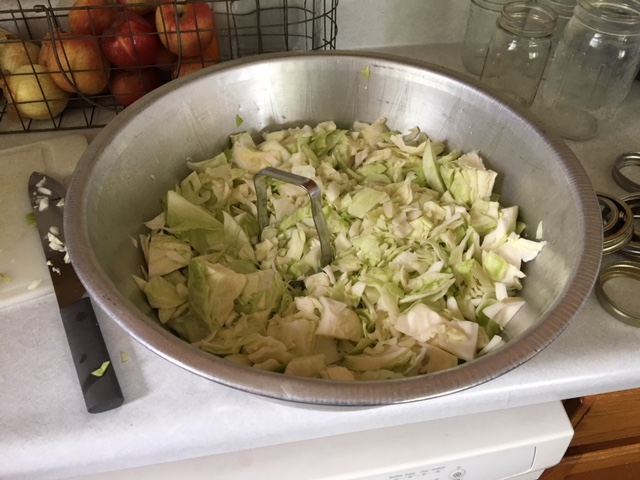

2. Tightly pack a sterilized hot quart jar with the chopped cabbage.

3. with a butter knife, make a well to add 1 tablespoon of vinegar and 1 tablespoon of pickling salt.
4. pour boiling water into the jar, leave 1 inch head space.
5. use the knife to work all of the bubbles out of the jar.
6. clean the top of the jar and seal tightly.

7. set the jars away from the house. I have a friend that has allowed me to put these in his shed. Make sure that you have something under the jars as they will spill over when they are fermenting. When they have stopped fermenting they are ready to eat.
Thanks for the memory Big Mom.
We started making our own laundry detergent about a year ago and then suddenly it just became easier to buy a “green” detergent and fabric softener. So, for the last couple of months that was what we were using. However, I have recently had eczema reappear. Whenever this happens, I try to evaluate what I have had to eat or what I have contacted that could have set it off. After carefully ruling everything out, it has come down to the detergent and fabric softener. So, I have once again mixed the ingredients of the homemade detergent and I am using vinegar as a fabric softener. I have seen almost an immediate improvement. The detergent that I mix is dry, but it dissolves easily and does a very nice job cleaning the clothes and making them smell fresh.
I wish I could give credit to the website where I long ago found the recipe, but I simply do not remember.
Laundry Detergent with Borax
2 cups of borax
2 cups of washing soda
2 cups baking soda
1 bar of Felsnaptha (grate using a cheese grater).
Simply mix all the ingredients together in a container. Use 1/8 cup for a regular (medium) load of laundry.
During our Hippy Weekend, I saw my little granddaughter after her bath. Unfortunately, she seems to have inherited the sensitive skin gene and she had several patches of eczema. We decided to research some websites that had recipes for laundry detergent without the Borax. It appeared that most people were substituting the borax with the baking soda. We followed the suggestions and mixed the following detergent.
Laundry Detergent without Borax
2 cups washing soda
3 cups baking soda
1 grated bar of Felsnaptha.
Mix all of the ingredients and use 1/8 cup for a medium load of laundry.
 Another Hippy Weekend Success!!!!
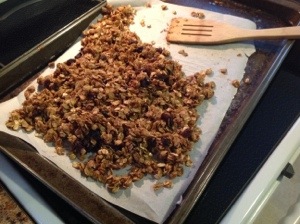
When you have a Hippy Weekend, you must make some really good granola. This recipe made our Sunday morning healthy and tasty.
3 cups organic oats
1/3 cup wheat germ
2 teaspoons cinnamon
1 teaspoon salt
1/8 cup brown sugar
1/4 cup canola oil
1/2 cup honey
1/4 cup molasses
1 teaspoon vanilla
2/3 cup organic raisins
1. preheat the oven to 325 and line a baking sheet with parchment
2. combine the oats, wheat germ, cinnamon, salt, and brown sugar in a medium bowl.
3. in a separate bowl, combine the honey, molasses, oil and vanilla. Pour over the oat mixture and stir until the oats are thoroughly coated.
4. spread the mixture on the baking sheet and bake for 10 minutes.
5. remove the pan from the oven and stir the granola.
6. add the raisins
7. cool and store in an airtight container.
On this morning, we combined ours with some of our homemade yogurt and fresh strawberries.
(We thought that we might add some flax meal and substitute the molasses with sorghum. We may also decide to use other dried fruits)
 Another Hippy Weekend Success!!!!!
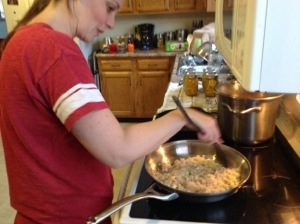 Our dinner of soup beans and corn bread must have sauerkraut if it is to be a true southern meal. I had canned some sauerkraut last fall and brought it to add to our meal. Again, if I can anything, Big Mom is always in my memory talking me through the process.
Canned Sauerkraut
I usually use 2 or 3 heads or cabbage. I put these in a big bowl and use a cabbage chopper to finely chop the cabbage.
I very tightly pack the cabbage into hot quart jars. I add 1 tablespoon of canning salt and 1 tablespoon distilled vinegar on top of the cabbage. Then, I fill the jar with boiling water.
Insert a butter knife into the jar to work out all of the air bubbles. If the water level falls below 1/2 inch, add additional water.
Seal the jar with a lid and ring.
This next part is very important. I store these in my shed with a plastic container under the jars. The jars cannot be disturbed until they have “worked” or fermented. They will smell badly during this process and it will usually take several weeks for the entire process to be completed.
Cooking Sauerkraut:
Open the canned sauerkraut, drain and thoroughly wash the kraut.
In a skillet, add enough canola oil to lightly cover the bottom of the pan.
Add the kraut.
Serve hot on top of your soup beans.
I like to knit.
Food Photography & Recipes
poetry, writing, 3WW, doodles, screenwriting, photography, art, self-expression
Just another WordPress.com site
making memories through food, wine and travel
living a life of faith in a weird, wonderful, and wacky world
 Cindy-just-living